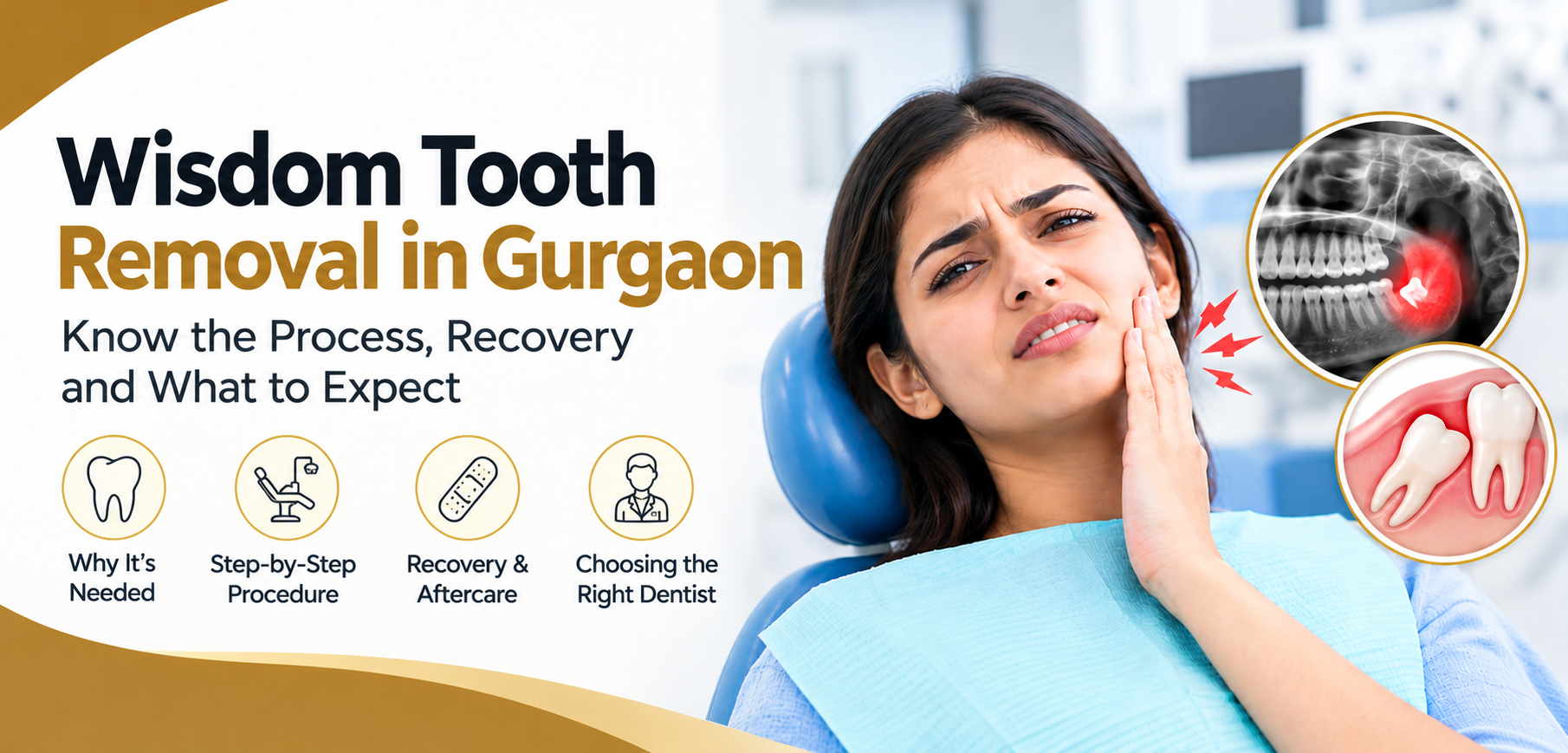
Wisdom Tooth Removal in Gurgaon: What You Need to Know
If you have a dull ache at the back of the jaw, swollen gums or a tooth that has only slightly come out, then you may have an issue with your wisdom tooth. The pain involved or lack of information about the procedure is a reason why many people put off treatment. This blog will discuss about the process of wisdom tooth removal in Gurgaon, including why it is required and how they recover.
Wisdom Teeth: What They Are and Why They Cause Problems
Third molars are commonly known as wisdom teeth and are the last teeth to grow in, typically between the ages of 17 to 25. They are found at the very back of the mouth, one on each corner, and most adults will have four. The main issue is space. In most cases, the extra molars have nowhere to fit in the mouth, causing them to grow at an angle, lie beneath the gums or crowd the tooth ahead.
A wisdom tooth that has not come through is known as an impacted wisdom tooth, and is the most common cause of people searching for wisdom tooth removal in Gurgaon. These teeth are hard to clean with a brush and food and bacteria easily accumulate around these teeth causing them to decay and infect.
What is the Need for Wisdom Tooth Removal?
It is not always necessary to have to remove all four wisdom teeth. In the event that a tooth has grown in all the way and it is in good condition and can be brushed properly, the dentist might just monitor it.
They are typically recommended for teeth that are frequently painful or swollen, or for those that have gum disease, or that decay or press into neighbouring teeth. Food getting trapped again and again, persistent bad breath, difficulty opening the mouth and the formation of a cyst around an impacted tooth are other common reasons.
There are some wisdom teeth that never give a twinge of pain, but they still do damage to nearby teeth without you ever realizing it. This is why it's important to get a dental X-ray even if you feel okay because it will reveal what is going on below the gum.
What is the Process of the Procedure?
Understanding the process can help reduce a lot of the stress. It begins with a consultation, where your dentist examines your mouth and takes an X-ray, usually an OPG, to see the position of the tooth, the shape of its roots and its closeness to the jaw nerve.
Your dentist should be made aware of any medical conditions such as diabetes, high blood pressure, cardiovascular diseases, any medications (particularly blood thinners), and any allergic reactions.
Local anaesthetic is used on the day of treatment so the area is numb, you won't feel any pain, but you will feel pressure and/or movement. If the tooth is completely visible, it can usually be extracted in about 20 to 30 minutes.
A small hole in the gum, the removal of a small amount of bone and sometimes the division of the tooth into sections that come out safely are needed to remove an impacted tooth. Stitches are inserted where necessary and many of these will dissolve naturally. You will then be asked to bite on gauze to stop the bleeding and then be given clear instructions for what to do at home.
Recovery and Aftercare
Most patients can cope with some post-procedure discomfort by taking the pain relievers and antibiotics prescribed by their dentist. The numbness gradually subsides over several hours and there may be some oozing of blood in the first day. Usually swelling and stiffness of the jaw is most severe at about the 2nd or 3rd day and settle afterwards. Most people feel much better within a week, the gum takes one-two weeks to heal and the socket underneath heals for a couple of weeks thereafter. Surgical extractions and lower wisdom teeth tend to take a bit longer than upper wisdom teeth.
Proper aftercare will safeguard the healing area. Apply ice pack on the cheek on the first day, rest with the head elevated and have soft cold food like curd, khichdi, porridge, soup and banana. Gently rinse with warm salty water after 24 hours. Don't bite down on the socket early in the healing process, or rinse it vigorously, because suction can wash out the blood clot that seals the socket, and don't use a straw to drink fluids. Avoid smoking, tobacco, gutka and paan as it slows down the healing process and increases the chances of complications.
Keep an eye out for signs that may indicate a problem. Severe pain that starts to occur around the third to fifth day may mean you have a dry socket, which occurs when the clot has dislodged, and it's easily treated by your dentist. If swelling, pus, fever, heavy bleeding that will not stop when lightly pressed, or difficulty breathing or swallowing increases, then prompt medical attention is required.
Post-Procedure Recovery
Most patients can cope with some post-procedure discomfort by taking the pain relievers and antibiotics prescribed by their dentist. The numbness gradually subsides over several hours and there may be some oozing of blood in the first day.
Usually swelling and stiffness of the jaw is most severe at about the 2nd or 3rd day and settle afterwards. Most people feel much better within a week, the gum takes one-two weeks to heal and the socket underneath heals for a couple of weeks thereafter. Surgical extractions and lower wisdom teeth tend to take a bit longer than upper wisdom teeth.
Proper Aftercare
Proper aftercare will safeguard the healing area. Apply ice pack on the cheek on the first day, rest with the head elevated and have soft cold food like curd, khichdi, porridge, soup and banana. Gently rinse with warm salty water after 24 hours.
Don't bite down on the socket early in the healing process, or rinse it vigorously, because suction can wash out the blood clot that seals the socket, and don't use a straw to drink fluids. Avoid smoking, tobacco, gutka and paan as it slows down the healing process and increases the chances of complications.
Signs of Possible Complications
Keep an eye out for signs that may indicate a problem. Severe pain that starts to occur around the third to fifth day may mean you have a dry socket, which occurs when the clot has dislodged, and it's easily treated by your dentist.
If swelling, pus, fever, heavy bleeding that will not stop when lightly pressed, or difficulty breathing or swallowing increases, then prompt medical attention is required.
Choosing a Dentist for Wisdom Tooth Removal in Gurgaon
It really can be the difference between the dentist you choose and the impacted teeth you have. Your dentist should be able to discuss your X-ray in layman's language and let you know whether your tooth is in need of extraction or not.
It is essential that the surgeon has experience in dental extractions as these cases are more complex and require a skilled and careful hand. Ensure good hygiene and sterilisation – a clean clinic reduces the risk of infection.
Before starting treatment, you should also be told what the treatment will be and what is the cost of the treatment, the cost of the treatment is dependent on the complexity of the extraction, anaesthetic used, and imaging needed.
Last but not least, make sure that the clinic will provide you with follow-up care after the procedure and that you can easily reach them from your home or office, in case a follow-up visit is necessary soon after the procedure.
Conclusion
Wisdom tooth issues do not normally resolve themselves and can worsen the further down the road that care is waited. If the diagnosis is correct, and a trained dentist is used to performing this procedure, and if it is taken care of correctly and appropriately, most patients have a very easy experience of having their wisdom teeth removed, and are able to recover from the experience very easily.
If you're thinking of getting wisdom tooth removal in Gurgaon, then don't dismiss any pain or swelling at the back of your mouth. Get it checked out early, then you'll know what's going on with your tooth and move forward with confidence.
Frequently Asked Questions
1. Wisdom teeth removal is not painful.
No, you shouldn't feel any pain during the procedure as it is numbed with local anaesthetic. This may be accompanied with some pressure or movement – normal. Following the initial numbness, your dentist will prescribe medications to manage mild pain, swelling and jaw stiffness for 2 to 3 days.
2. How long will it take to remove wisdom teeth?
Typically, a simple extraction of an entire tooth that is visible takes about 20 to 30 minutes. If the tooth is impacted, and requires a surgical approach, it may take longer based on the position of the tooth and the shape of the tooth roots. Your dentist will be able to give you a clearer picture once he sees your X-ray.
3. What is the recovery time for wisdom tooth extraction?
Most people are feeling much better within a week. Typically, swelling and discomfort are most pronounced on day two or three and then diminish. The gum usually heals in 1-2 weeks, but in some cases (usually lower wisdom teeth or surgical extractions) it may take a bit longer.
4. What am I not able to eat after wisdom tooth extraction?
Keep giving soft and cool food like curd, khichdi, porridge, soups, banana and mashed potato for initial few days. Don't eat anything that is very hot, spicy or hard, and don't use a straw to sip liquids as sucking may dislodge the blood clot. You can gradually resume your regular diet when you feel more comfortable.
5. Do all wisdom teeth have to be pulled?
Not always. If a wisdom tooth has erupted completely, it is healthy and is easily cleaned, the dentist may simply watch it. It is recommended for removal if the tooth is impacted, if it is causing recurrent pain or infection or if it is affecting the adjacent tooth. A dental X-ray will assist your dentist make a decision for you.