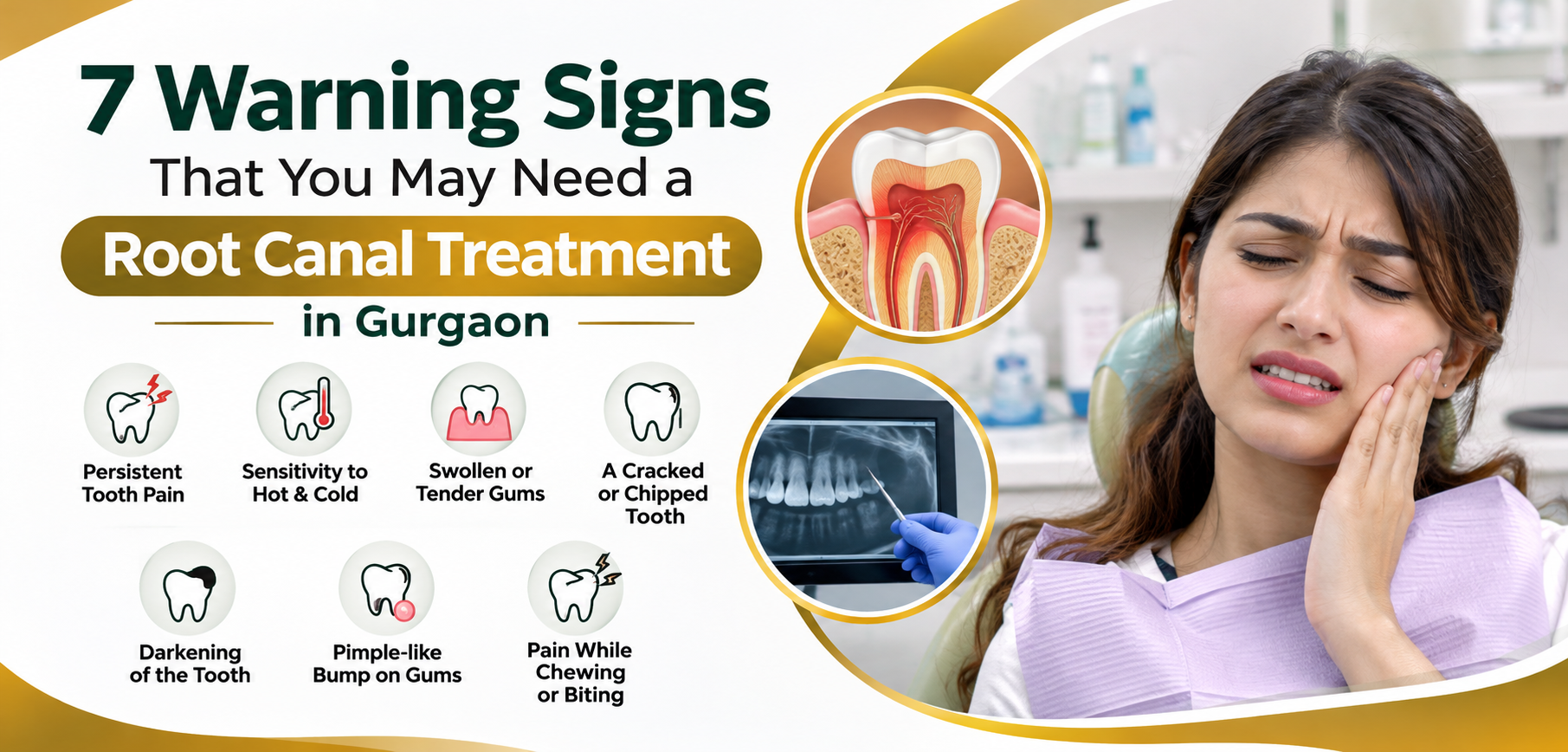
7 Warning Signs That You May Need a Root Canal Treatment in Gurgaon
Tooth pain that won't go away is rarely something you should just ignore. It's very often a sign that the pulp inside the tooth is infected or damaged and the only way to save it is root canal treatment in Gurgaon .
The good news is that modern root canal treatment is actually quite quick, quite comfortable and far less painful than most people anticipate.
In this guide we look at the 7 warning signs that you may need a root canal, what happens if you put it off and how to go about choosing the right dentist so you can act early and protect your smile.
What Is Root Canal Treatment?
Root canal treatment, also known as endodontic treatment or root canal therapy (RCT), is the removal of infected or damaged pulp from inside the tooth, the cleaning of the internal canals and the sealing of the canals to prevent reinfection.
What Happens Inside the Tooth
The inner tissue of each tooth is called the pulp, and it contains the nerve and blood supply of the tooth. If deep decay or a crack allows bacteria to access the pulp, it can become inflamed and infected.
Infections on the pulp of a tooth will not heal on their own, and are generally ongoing and worsening. Unlike surface cavities, these types of infections cannot be healed on their own and will require treatment.
Why Dentists Recommend a Root Canal Instead of Extraction
keep your own natural tooth, rather than have it replaced, is always the best option. Preserving your tooth with a root canal not only saves your tooth, but also your bite and jaw alignment.
There’s also the cost and time involved for the placement of a dental bridge or implant to consider. Extraction is typically the last option considered when saving a damaged tooth is no longer possible.
7 Warning Signs You May Need Root Canal Treatment
Not all of these symptoms mean you will need a root canal, but they do warrant an immediate visit to your dentist.
1. Severe and Persistent Toothache
A deep, throbbing tooth pain that lasts a couple of days is an indication of a damaged or infected tooth pulp. The pain can be constant or intermittent and may radiate to your ear, jaw or temple.
Pain that keeps you up at night or is not managed by painkillers is a sign you should see your dentist as soon as possible.
2. Prolonged Sensitivity to Hot and Cold
If your tooth is damaged, you may experience lingering tooth sensitivity to hot and cold temperatures. To test this, see if the tooth is sensitive to hot and cold temperatures for a prolonged period (more than 30 seconds) after the stimulus is removed.
Tooth sensitivity to hot and cold is a classic indication of a damaged tooth that will require a root canal.
3. Pain When Chewing or Biting
If the tissue around the root of your tooth is infected or inflamed, you may experience pain when you bite down or chew. This pain may be one sided and may be more noticeable when you chew on hard foods.
Continuous chewing on the affected side of your mouth may worsen the condition and should be avoided.
4. Swollen or Tender Gums
If your gums around your tooth are inflamed and infected you may experience a toothache and gum swelling. The swelling may radiate to your face. Tooth and gum infection may also be indicated by a bad taste in your mouth.
5. Discoloration
A tooth that has turned a greyish, brownish, or darker shade may be experiencing pulp death or deterioration. This can occur from a deep cavity or injury. Often times there will be no pain associated with the injury or cavity.
If you notice any discoloration you should consult your dentist for a possible X-ray to ensure there is no decay present.
6. Pimple-Like Bump (Abscess) on the Gums
A small pimple like growth on the gums is called a dental abscess or a dental fistula. This growth will eventually rupture, and release pus. It will also cause a bad taste and bad odor in your mouth.
A fluid filled swelling will come and go, but that does not mean the infection has resolved, it is just draining.
7. Cracked/Chipped Tooth
Advanced decay or a traumatic event can cause a tooth to crack or chip, and expose the pulp. Even if the tooth does not hurt you still need to see your dentist as an infection can occur later.
It is always best to treat a damaged tooth as early as possible in order to protect the pulp. This may even prevent the need for a root canal at a later date.
What Happens If You Ignore These Warning Signs?
Waiting rarely makes things better. Here’s what happens to your mouth when you let an infected tooth go untreated.
Spread of Infection and Dental Abscess
When bacteria reach beyond the end of the tooth’s root, they can form a pocket of pus (abscess) in the gum or jaw. This infection can spread to the face and neck, and can become a medical emergency.
Bone Loss and Tooth Loss
If an infection is not treated for a long time, it can start damaging the bone that supports your tooth. The tooth becomes loose and needs to be removed.
Higher Treatment Costs Later
A tooth that could have been saved with a root canal may later need removal and other treatments, such as a bridge or implant. Early treatment is simpler, cheaper, and usually more convenient.
How Is a Root Canal Diagnosed?
Dental Examination and Pulp Testing
Your dentist will ask about your symptoms, and examine the tooth and gums. Simple tests, like tapping on the tooth or applying a cold stimulus, help assess the health of the pulp.
X-Ray and 3D Imaging (CBCT)
A dental X-ray shows the shape of the roots and any infection around them. In more complex cases, a CT scan (CBCT) gives the dentist a 3D image and greater detail on how to plan the treatment.
Root Canal Procedure: Step-by-Step
- Local anaesthesia: The area is numbed so you stay comfortable.
- Isolation: A small rubber sheet keeps the tooth clean and dry.
- Access opening: A small opening is made in the top of the tooth to reach the pulp.
- Cleaning and shaping: The infected pulp is removed, and the canals are cleaned and shaped with fine instruments.
- Filling: The cleaned canals are sealed with a biocompatible material.
- Restoration: The tooth is closed with a filling and, in most cases, protected with a dental crown.
Is Root Canal Treatment Painful?
This is the biggest fear patients have, but it is mostly a myth. With modern anaesthesia and techniques, a root canal feels similar to getting a regular filling. The pain people associate with root canals usually comes from the infection itself, not the treatment.
How Many Sittings Are Needed?
Many straightforward cases can be completed in a single sitting of about 60 to 90 minutes. Teeth with multiple canals, severe infection, or an abscess may need two or more visits.
Recovery and Aftercare Tips
- Avoid chewing on the treated tooth until it is fully restored.
- Take only the medicines your dentist prescribes.
- Brush and floss gently, and keep the area clean.
- Mild soreness for a few days is normal. Contact your dentist if pain or swelling increases.
- Get your crown or permanent restoration placed on time.
Root Canal Treatment Cost in Gurgaon: What to Expect
The price of root canal treatment at Gurgaon is determined by a few factors such as the tooth being treated, the number of canals, the technology used, and the requirement of crown afterwards.
Generally, the cost of treatment of front teeth is less as compared to molars, because front teeth contain less number of canals. Be sure to ask your dentist for a detailed estimate after X-ray, to avoid any un-expected costs.
Factors That Affect the Cost
- Type of tooth: Treating complicated front teeth can be different than treating premolars or molars.
- Technology: Utilization of digital X-rays, rotary endodontics and microscopes in procedures may affect price.
- Dentist's experience: Specialist endodontists may charge more than general dentists.
- Crown: Most treated teeth need a crown, which is usually an additional cost.
- Condition of the tooth: Severe infection or retreatment can add to the total.
Single-Sitting vs Multiple-Sitting Root Canal
For the majority of cases, a single visit root canal is time saving and convenient for the patient. However, the main concern for the dentist is the health of the patient and the tooth.
If the infection is severe, or the tooth is damaged to the extent that the tooth may break during treatment, then it may be in the best interest of the patient to split up the treatment into multiple visits to give the tooth a chance to fully heal.
How to Choose the Best Dentist for Root Canal Treatment in Gurgaon
Not all dental clinics are the same. When seeking root canal treatment in Gurgaon, look into the qualifications and experience of the dentist in endodontic cases. Look for technological assets available at the clinic such as rotary endodontics and digital X-rays.
The specialist can make the procedure less stressful, and if the treatment is successful, your natural tooth can last many years.
Qualifications and Endodontist Experience
Look for a dentist with a postgraduate degree in endodontics or one who is experienced in performing root canals. It is perfectly reasonable to inquire about how many root canals they perform monthly.
The Use of Technology
Various technological advances in endodontics, from rotary files, apex locators, digital X-ray machines, and dental operative microscopes, have created a faster, more accurate, and more comfortable endodontic experience for both the patient and the practitioner.
Hygiene and Patient Care
Always make sure that strict sterilization and contamination control procedures are in place. Before choosing a clinic, read reviews, check before and after cases if available, and make sure the clinic explains the process and cost before any treatment.
Conclusion
Severe tooth pain, sensitivity, pain while chewing, swollen gums, a darkened tooth, a pimple on the gums, or a cracked/decayed tooth should not be ignored. These may be warning signs of an infection and should be assessed to prevent worsening of the situation. It is best to act now to prevent complications and pain.
Don't wait for it to get more painful. Get your consultation for root canal treatment in Gurgaon . An experienced dentist can protect your natural tooth.
Frequently Asked Questions
Is root canal treatment safe?
Yes, root canal treatment is a proven safe and effective treatment to remove infection from within the tooth and to save the tooth.
How long does a root canal last?
With a good restoration and good oral hygiene, a tooth that has undergone a root canal treatment can last for many years, and in some cases for a lifetime.
Can I eat after a root canal treatment?
You can eat after the anesthesia wears off, but you should stick to soft foods and avoid chewing on the treated tooth until your dentist permanently restores it.
Can a root canal be avoided?
In most cases no. For early stages of infection, a pulpotomy (treatment of the pulp of the tooth) is a treatment option, but if it is a severely infected tooth then most likely it will require a root canal treatment or extraction.
Is a crown always necessary after a root canal?
Yes, most of the time, especially with the back teeth. After a root canal treatment, a tooth becomes more brittle and a crown is necessary to prevent it from fracturing.