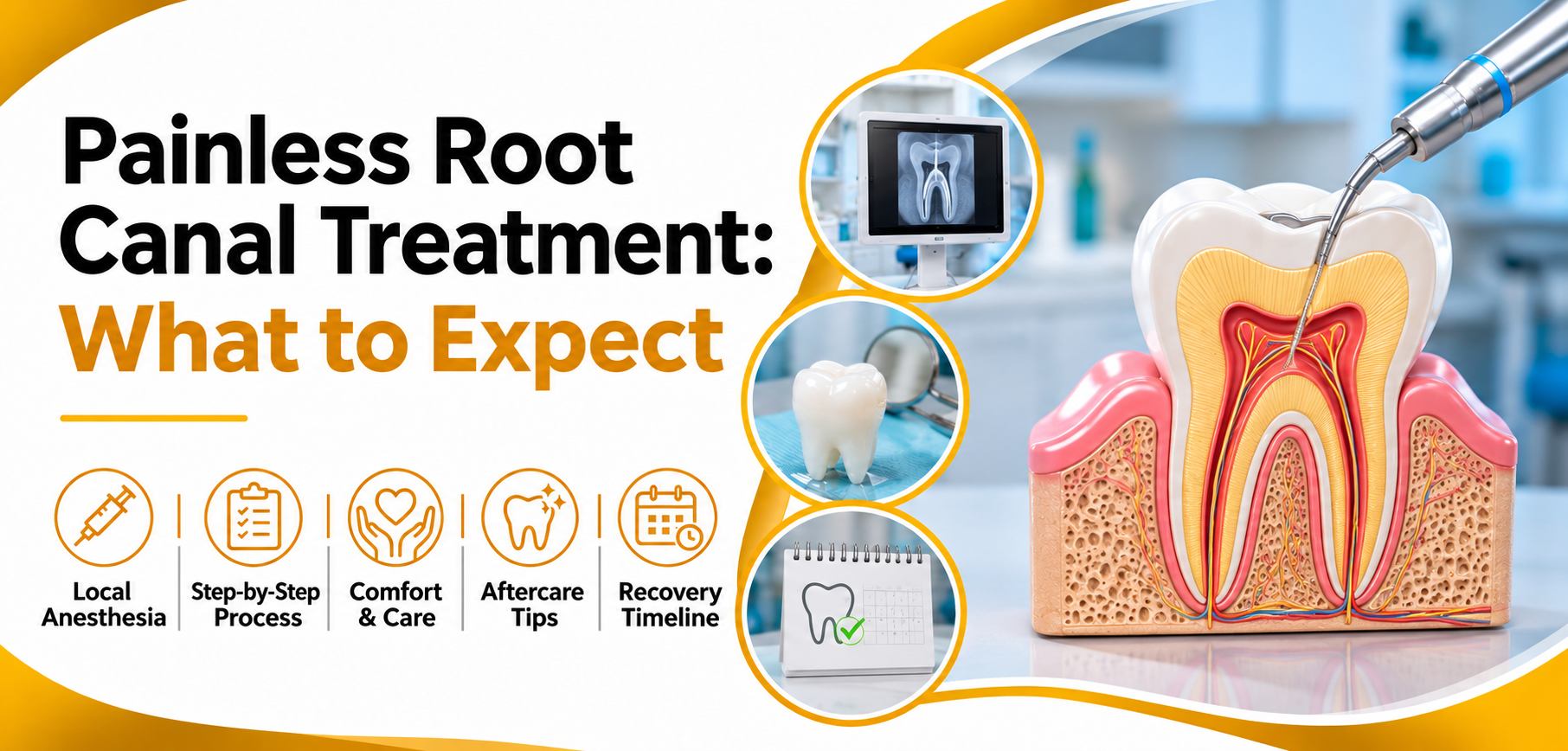
Painless Root Canal Treatment: What to Expect
Few dental terms cause as much dread as "root canal." If you are searching for painless root canal treatment, you have probably heard a frightening story from a friend or relative. The reality is far more reassuring than that story, though a few details are worth understanding before you sit in the chair.
Is Root Canal Treatment Really Painless?
For most patients, yes. A modern root canal is carried out under local anaesthesia, and the experience is comparable to having a deep filling placed. The American Association of Endodontists makes the same point: the procedure is meant to relieve pain, not cause it.
"Painless" does not mean you will feel nothing at all. You may notice pressure, vibration, and the sound of the dental handpiece. You may also tire of keeping your mouth open. What you should not feel is sharp pain, and if you do, you can tell your dentist at once so that more anaesthetic can be given.
The pain people associate with root canal almost always comes from the infected tooth, not from the treatment. A tooth with inflamed or infected pulp can throb for days. Treatment removes the source of that pain.
Why Does a Root Canal Have Such a Painful Reputation?
The reputation has been established long before technology. There's been a lot of changes, decades ago, anaesthetic wasn't as refined, instruments not as quick, and many of the patients arrived when the infection had already taken its toll. The experiences happened and there were many years of this spread through families.
There is another reason. Affected tissue may not be as numb as healthy tissue. A dentist understands this, and they try to adjust their method accordingly, but it's why a root canal on a severely infected tooth may require more attention than an early root canal. When it comes to dentistry, it's best to see the dentist immediately if there is any trouble.
How Is a Root Canal Made Painless Today?
Comfort is designed-in throughout. Knowing what to do can make you feel more in control.
Your dentist first performs a check-up and takes an X-ray to determine the root shape and the level of infection. The area is then numbed, the topical gel sometimes being a first stage of the process, so that the injection is not very noticeable. A thin rubber piece called a rubber dam provides isolation of the tooth, maintains a clean field and prevents instruments from touching other parts of the mouth.
The affected pulp is then cleaned out and the inner canals are cleaned, shaped and sealed. Numerous clinics are now employing rotary instruments which shape canals faster than hand file which reduces the time in the chair. The extent of the infection, the number of canals and the condition of the tooth will determine whether or not a single or double visit is required to complete the treatment. Your dentist will inform you which one is applicable to you.
Those who have a significant dental fear may want to find out if there is mild sedation offered at their dental office. Well, it's a very good question, and a good dentist will take it seriously.
Can You Have a Root Canal Without Anaesthesia?
It is technically feasible sometimes, but usually not advisable. If the nerve within the tooth is already dead, the tooth may not feel much. The surrounding tissues, however, remain sensitive and the deeper portions of the canal can catch you off-guard.
If you're looking for a painless root canal, but are scared of needles, talk to your dentist about your fear of needles instead. Topical numbing gel and slow, gentle injection render the needle nothing more than a minor worry, rather than a major one. Without anaesthetic, it is more likely to create a painful root canal than a painless one.
What Will You Feel After the Treatment?
After the anaesthetic has passed, the tooth and gum around it may be tender for one or two days. Biting down might be a little sensitive initially. This is normal and will typically pass, and your dentist will recommend the best way to deal with pain.
Otherwise, pain that worsens after the first few days, swelling in the face or gum, or fever are different. These are not a part of the normal healing process and you should seek the advice of your dentist as soon as you can.
One additional step is a significant step. Root canal treated teeth are more susceptible to fracture and generally require a crown or adequate filling. It's a common reason that treated teeth fail to hold up when the step is omitted. If the tooth is restored properly and maintained in good condition, the chances of success are excellent, with over 90 percent for many decades.
Why Waiting Makes Things Harder
You might think to hope that the toothache will go away. The pain may eventually subside, but this does not necessarily indicate that the problem has resolved itself, it may mean the nerve has died off. Can become a deep-seated infection and penetrate into the bone around the root.
An early root canal is shorter, simpler and more comfortable than an abscessed tooth root canal. The other alternative is extraction, but this is not as good as a natural tooth, and will take longer and cost more to replace with a bridge or implant. While in most cases, saving the tooth is the better option, your dentist will discuss with you based on the condition of the tooth.
How Do You Choose a Clinic for Painless Root Canal Treatment in Gurgaon?
Look for a dental office that will clearly outline the treatment plan prior to treatment. Inquire about the dentist's experience with root canals, pain-management techniques, if he or she uses digital X-rays to check the roots, and how many visits will be needed. You should also ask the dentist for the final crown's quote so that you don't have any surprise fees.
Pay attention to the way that questions are answered. If the dentist shows that he or she is listening and is trying to put your concerns of pain to rest, this is a good indication.
If you live in Gurgaon or the surrounding area and have any questions about the procedure, World of Dentistry is a great place to take a look at your tooth. The initial step towards comfortable and effective dental care is a proper diagnosis if you are seeking Painless Root Canal Treatment in Gurgaon.
Conclusion
A root canal doesn't have to be the nightmare that the old tales imply. If treatment is undertaken in the early stages, by a careful dentist, and under appropriate anaesthetic, painless root canal treatment is a feasible treatment.
Do not ignore a tooth problem if it hurts, or if it causes you pain. Schedule an appointment, ask questions, and get your dentist to tell you what will happen.
Frequently Asked Questions
Is painless root canal treatment really possible?
Yes. Modern root canal treatment is performed under local anaesthesia, and most patients describe it as similar to having a filling. You may feel pressure or vibration, but you should not feel sharp pain. If you do, your dentist can give more anaesthetic.
Does a painless root canal procedure need more than one visit?
Not always. Multiple visits are often required for many root canals. This is dependent on the tooth, the number of canals and the severity of the infection. Modern methods and local anaesthetic can make a root canal painless procedure possible. Your dentist will confirm, upon examination of the tooth, and the X-ray.
How long does pain last after a root canal?
Mild tenderness in the treated tooth is common for a few days after treatment and usually improves on its own. Pain that worsens, facial swelling, or fever should be checked by your dentist without delay.
Can I have a root canal without anaesthesia?
It may be possible in a tooth whose nerve has already died, but it is rarely recommended. The surrounding tissues can still be sensitive. Local anaesthesia is the standard way to keep the procedure comfortable, and your dentist can make the injection far gentler.
Is it better to pull the tooth than to have a root canal?
In most cases, saving your natural tooth is preferred. A root canal keeps the tooth in place and avoids the extra treatment that a bridge or implant needs. Your dentist will recommend what is suitable after examining the tooth.