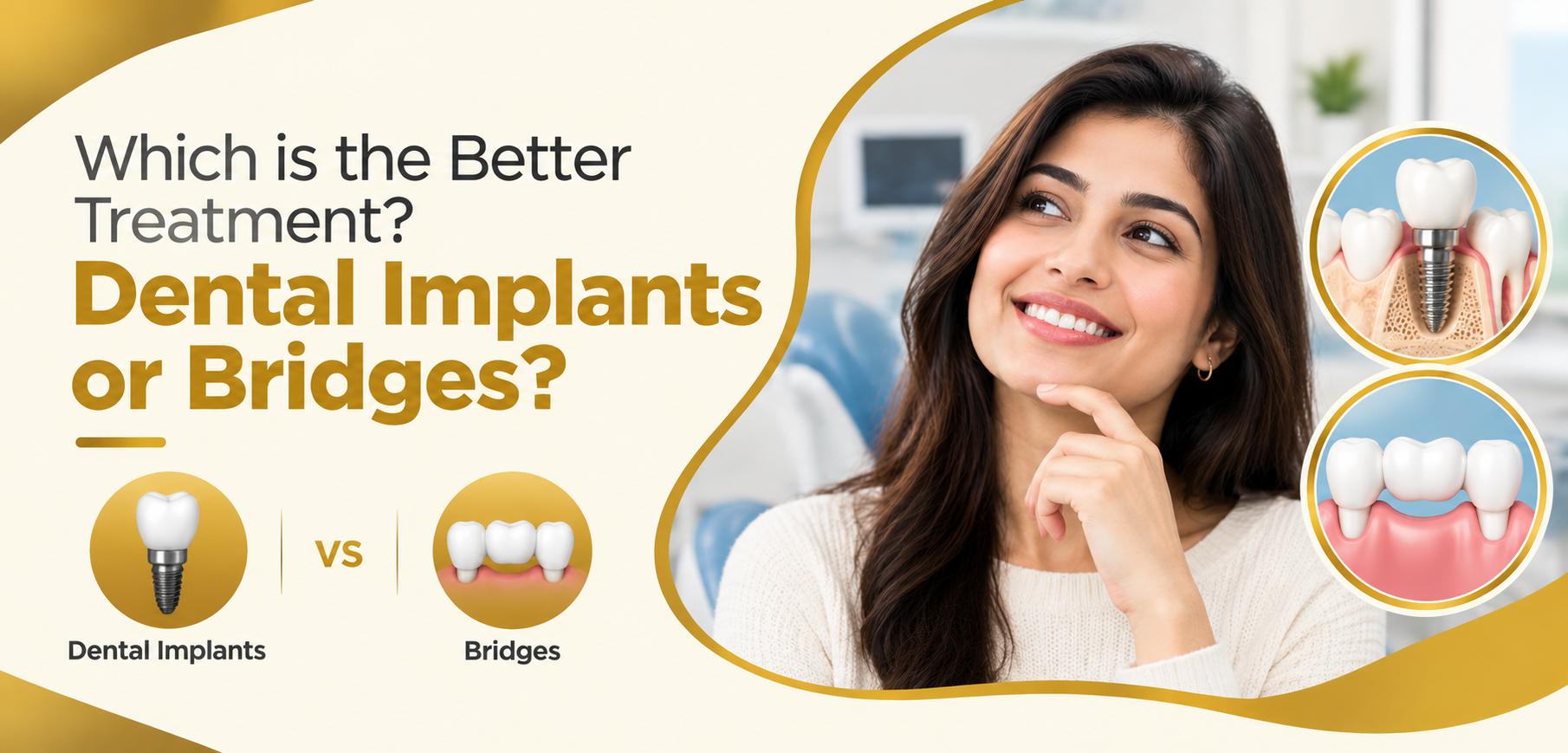
Which is the better treatment? Dental Implants or Bridges?
Having a missing tooth may impact more than just your smile. It can make chewing hard, alter a person's speech and occasionally have an impact on the adjacent teeth. Fortunately, there are multiple options available to replace a missing tooth and two of the most common are dental implants and dental bridge.
Which one is the better, though?
It's hard to give you a definite answer, since it will vary depending on your oral health, budget, lifestyle, and long term goals. Both treatments can restore a smile and provide function but in very different ways.
Here we're going to discuss the advantages and disadvantages of dental implants vs bridges in an easy-to-understand way so that you can make an informed decision.
What Is a Dental Implant?
A dental implant is a replacement for the entire missing tooth, including its root.
A small titanium implant is surgically placed in the jawbone, which eventually fuses with the bone. After healing, a crown is placed on top of the implant and this forms a natural-looking replacement tooth.
A major advantage of an implant is that there is no need to change neighbouring teeth.
The other advantage dental implants bring to the table is that they can also help preserve the jawbone following tooth loss; since the implant stimulates the bone much like a natural tooth root does.
So what is a Dental Bridge?
A dental bridge is a method that replaces a missing tooth with the teeth adjacent to it providing support.
A conventional bridge typically contains one or more artificial teeth which are supported by crowns covering the adjacent teeth. A bridge is not an implant and will not replace the tooth root.
Patients who do not want to undergo implant surgery may be a good candidate for bridges.
What is the difference between Dental Implants and Bridges?
The most significant difference is the way each treatment is backed up.
A dental implant is anchored in the jaw, just like a natural tooth root. A dental bridge is supported by neighbouring teeth.
This variation is able to impact treatment time, upkeep and long lasting oral health.
Which Looks More Natural?
With proper design and fitting, either dental implants or bridges can give you great cosmetic results.
An implant is self supported and can be very similar in appearance and function to a natural tooth. Crown is custom designed to match the colour, shape and appearance of the surrounding teeth.
A good quality bridge may be as well also look natural and also match in with the smile perfectly.
Both procedures can give an appealing appearance for many patients. Your dentist will be able to advise you on which one is likely to provide the best result.
Which is Better for Oral Health?
The important advantage of dental implants is that it replaces the missing tooth root. It could be useful in minimizing the bone loss that is usually seen following the loss of a tooth.
A typical bridge is not a substitute for the root. It also is supported by the neighbouring teeth, so they must be healthy and strong enough to support the restoration.
A bridge is an effective treatment for replacing a tooth even if implants are not suitable or if the patient doesn't want to have a surgical procedure done.
Which Lasts Longer?
With proper care, you can enjoy dental implants or bridges for many years.
The duration of either treatment is affected by the oral hygiene, chewing habits, general dental condition and regular dental visits.
Dental implants are considered to be a long-term tooth replacement option and, if cared for properly, can last for many years.
However, bridges can also be used to achieve long term results, but may require maintenance or replacement down the road.
Supporting both restorations will be best achieved by keeping teeth clean and visiting the dentist regularly.
Which cost less, which is better?
The expense of a dental bridge may be less expensive than a dental implant. There are many factors, though, which may result in a different overall cost, depending on the number of teeth that need to be replaced, the state of your mouth and the treatment you need.
There are a number of possible steps to an implant, ranging from implant placement to healing and crown placement. A bridge can be made in fewer appointments and can be done sooner.
Don't select based on the cost of the treatment alone, but also the long-term benefits and maintenance.
What is the duration of the treatment?
The time for treatment also makes a big difference.
Once the teeth to hold the bridge in place are prepared, a dental bridge can be made fairly quickly.
The placement of dental implants generally takes longer as the implant must fuse with the jawbone before the final crown is secured. Sometimes, other techniques are also required prior to implant placement.
Once your dentist examines your teeth and jawbone, he or she will be able to give you a specific schedule.
Which option is best for you?
If you:A dental implant might be a viable option:
- Looking for a permanent dental replacement.
- Possess enough healthy jawbone or are good candidates for bone-grafting treatment.
- Desire to not change adjacent healthy teeth.
- Opt for something that feels like a real tooth.
- Are ready for a longer treatment period.
If you have one or more of these characteristics, a dental bridge might be a good option:
- Looking to replace a lost tooth without an implant procedure.
- Choose a possible quicker treatment.
- Have healthy neighbouring teeth that can support a bridge.
- Are looking for a potentially more affordable initial option.
These, however, are general considerations. Each mouth is unique and only a dental examination by a professional will help decide.
Which is better, Dental Implants or Bridges?
So there is no right or wrong solution to the question “dental implants vs bridges: which is better?”
However, for certain patients, using an implant could be the best solution in the long term, as it not only replaces the visible tooth but also its root. A bridge could be a useful, effective and more convenient replacement for a missing tooth for others.
Your dentist will keep in mind your jawbone, nearby teeth, gum health, complete oral health, budget plan, and choices while recommending a therapy.
Replacing a missing tooth is more than just for a better smile. With the proper treatment, you can regain the ability to chew comfortably, maintain your oral health and avoid undesirable changes associated with tooth loss.