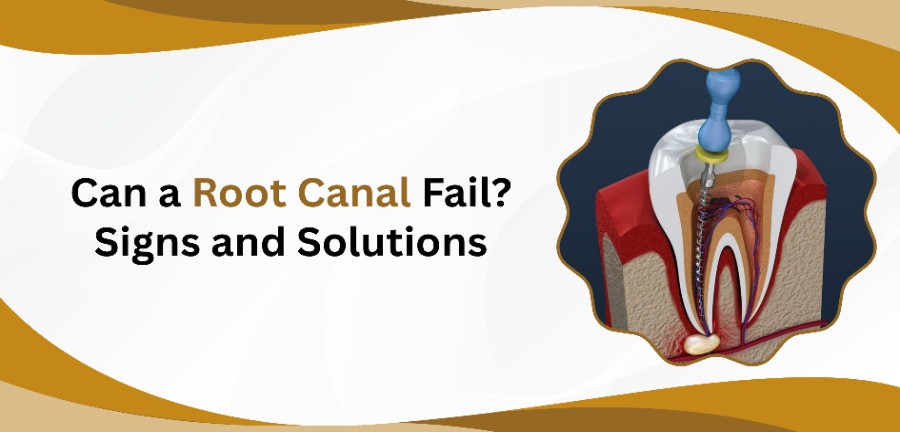
We know that a Root Canal Treatment is one of the most effective ways to save your tooth if decay or infection has caused damage too severe for your body to repair on its own. The result is that most patients never need treatment of the treated tooth again; more than 95 percent have a lifetime of function. But, as with any medical or dental procedure, there's always a slight risk of complications.
The Reality: Can a Root Canal Actually Fail?
The short answer is yes. The goal of the procedure, as you know, is to remove infection and seal up the tooth; however, a "failure" occurs when that original infection returns or a new infection develops. This may happen in the days or weeks after the procedure or even decades later.
What are the signs of root canal failure after years?
Having a tooth treated long ago gives rise to an unsettling issue. You might not expect to feel anything because the tooth nerve was removed during the initial procedure. In infections, although bone and adjacent soft tissues have an intact protective pain-sensing mechanism, they can still send noxious stimuli.
Watch for these specific signs of root canal failure after years:
- Long-lasting pain or soreness: A tiny bit of tenderness is to be expected right after an operation, but discomfort that develops many years later, particularly whenever biting or placing strain on the tooth, is a huge signal.
- Gum Swelling: Look for a small, pimple-like bump on the gums (dental abscess). This is commonly indicative of pus draining from an infection at the bottom of a root.
- Discoloration of the Tooth: If you notice your tooth becoming darker or grayer than its neighboring teeth, it could mean damage inside the tooth or a breakdown in the filling material.
- Sinus Congestion: Surprisingly, an infection of the upper back teeth can "seep" into the sinus cavities, resulting in ongoing sinus pressure or spinal referred pain.
- Mobility: If a previously firm tooth feels like it has become loose, the bone is being resorbed due to an active cycle of infection.
Why Do Root Canals Fail?
Before discussing how to fix a failed root canal, it is helpful to understand why it happens. The most common reasons include:
- Complex Anatomy: Some teeth present with additional canals that are extremely narrow or curved, which can complicate the situation and typically go undetected without advanced imaging.
- Deferred Treatment: If a root canal wasn't immediately followed by placing a permanent crown, bacteria might have reentered the tooth.
- New Decay: A new cavity at the margin of a crown may facilitate bacterial re-infection into the root canal space.
- Fractures: A minuscule crack in the root can open a door to bacteria entering through the sterile environment established at the first treatment.
How to Fix a Failed Root Canal
If you are experiencing symptoms, do not panic. A failed root canal does not necessarily mean you will lose the tooth. At World of Dentistry, we explore several specialized solutions to restore your health.
Do not panic over it in case of having symptoms. A root canal that fails does not mean you will lose the tooth. We are here with a few niche solutions at World of Dentistry focused on your health restoration.
- Endodontic Retreatment: This is the solution in most cases. In such a case, the dentist must reopen the tooth, remove the filling material (a plastic-like substance called "gutta-percha"), and then finish cleaning and sterilizing the canals again. He uses magnification tools to identify missed canals or unusual anatomy (Dr. Rishi Rana). The tooth is then sealed back up, and a new crown is placed on top of it.
- Apicoectomy (Root-End Surgery): In cases that cannot be treated in a standard retreatment manner and still cannot reach the tip of the root, an apicoectomy is performed. It consists of opening the gum tissue, if needed, and introducing a tiny but effective filling to seal the canal (small tube that comprises the root) from bottom to top after removing the infected tip.
- Dental Extraction and Implants: If a tooth is very badly broken or the bone loss at that site has been excessive, then the removal of the tooth may just be the most predictable course of action. Dr. Charu Rana specializes in replacing these teeth with modern dental implants that look, feel, and function just like natural teeth!
How much does root canal retreatment cost?
A common question patients ask is, "How much does root canal treatment cost?"
Retreatments cost more than a regular root canal done from the beginning. This is because the process is more complicated; it involves not just removing the old crown and filling, but also doing a deeper clean. Although prices differ based on where the tooth is located (molars tend to be more expensive) and how extensive the infection is, retreatment is almost always markedly less than an extraction with a bridge or dental implant.
We offer our pricing breakdown during your consultation at World of Dentistry so you can choose what is best for both your wallet & health.
Prevention: Lowering the Risk of Failure
Keep your root canal for a lifetime with these essential steps:
- Crown It: Make sure you get the permanent crown, and skip out on no step. It helps to protect against bacteria.
- Get regular check-ups: X-rays can help Dr. Rishi Rana find a reinfection before it becomes painful and widespread.
- Floss a Day: How not to get animal tooth decay in your old root canal.
Conclusion
No one likes the idea of a problematic or failed root canal, but this is where modern dentistry shines, as we have very effective options available to restore your tooth & stop any arising discomfort. So, whether you require a basic retreatment or an advanced surgical treatment, the team at World of Dentistry, the Best Dental Clinic in Gurgaon, offers "premium-level, patient-focused care."
If you experience any post-root canal failure signs, such as swelling or pain while eating, do not wait for the situation to deteriorate. If you want to know more, contact us today for a detailed diagnosis of the issue and talk to Dr. Rishi Rana or Dr. Charu Rana about it. We're here to help you preserve that natural smile for a lifetime!